Why Airliners Cruise at About 35,000 Feet
Airliners usually cruise between 31,000 and 38,000 feet. See why thin air, engine behaviour and weather make that the sweet spot, and what limits go higher.
In this article
Most passenger jets cruise somewhere between 31,000 and 38,000 feet, which is about 9,400 to 11,600 metres. The short reason is that the air is thinner up there, so the aircraft meets less resistance, while the engines still have enough air to work well. This article lays out the trade-offs that fix the height.
The air gets thinner as you climb
NASA Glenn Research Center explains that air pressure falls with height, because there is less air above to press down. Density, which is how much air is packed into a given volume, falls too. Aircraft designers use a standard atmosphere model for this, since the forces on a wing and body depend directly on air density.
Temperature behaves differently in different layers. In the troposphere, from the ground to about 11,000 metres, it drops steadily with height. In the lower stratosphere, from 11,000 to 25,000 metres, NASA describes it as staying constant. Airliners cruise near the boundary between these layers.
Less drag, less fuel
Drag is the air's resistance to a moving object. In thinner air there is less of it. Science ABC says this means the plane needs less fuel and so costs less to run. Thin air also means a wing makes less lift at a given speed, so the aircraft has to fly faster, and that is part of why airliners cruise at high speed rather than slow.
Wikipedia's article on cruising flight puts the balance this way: cruising altitude is where higher ground speed is weighed against falling engine thrust and efficiency at greater heights. There is no single best number, only a compromise.
Engines have limits too
A jet engine needs air to burn its fuel. The higher the plane flies, the less air each engine swallows, so there is a point where the gain in drag is outweighed by lost engine performance. Science ABC adds that the very cold air, around minus 55 degrees Celsius at cruise height, helps jet engines run efficiently.
A smoother ride above the weather
Most clouds and storms are lower than the usual cruising band. Science ABC says planes up there usually avoid the clouds and turbulence they cause, although they can still fly through weather. The site also lists extra clearance above terrain, fewer bird strikes and more time for pilots to deal with problems as secondary benefits. It mentions a Rüppell's vulture that struck a plane at 37,000 feet in 1973, which shows that birds at that height are rare, not impossible.
Why not go even higher?
Higher flight brings its own problems. Science ABC notes that airliners are certified to about 39,000 to 43,000 feet, and that going beyond the safe limit risks stalling and loss of engine power. It cites the 2004 Pinnacle Airlines Flight 3701 accident as an example. Cabins also have to be pressurised to protect people from the low outside pressure, which is a structural limit.
- Climbing costs fuel, so a higher cruise is not always cheaper
- Engine thrust and efficiency drop as air thins
- A wing must fly faster, or at a higher angle, to carry the same weight
- Aircraft have certified altitude limits
Altitude changes during a flight
The best height is not fixed for a whole journey. As the plane burns fuel it gets lighter, and Wikipedia notes that the altitude giving the best fuel economy rises as weight falls. On long flights, pilots may therefore ask for a step climb to a higher flight level part-way through.
A flight level is the altitude in hundreds of feet, measured with a standard pressure setting. Flight level 350 means 35,000 feet by that convention.
The short version
Airliners fly high because thin air means less drag, cold air suits jet engines, and the weather is better. They do not fly higher still because engines lose thrust, wings need more speed, and certified limits apply. The usual band of 31,000 to 38,000 feet is where those factors balance.
Sources
- Earth Atmosphere Model, NASA Glenn Research Center
- Why Do Airplanes Need To Fly So High?, Science ABC
- Cruise (aeronautics), Wikipedia)
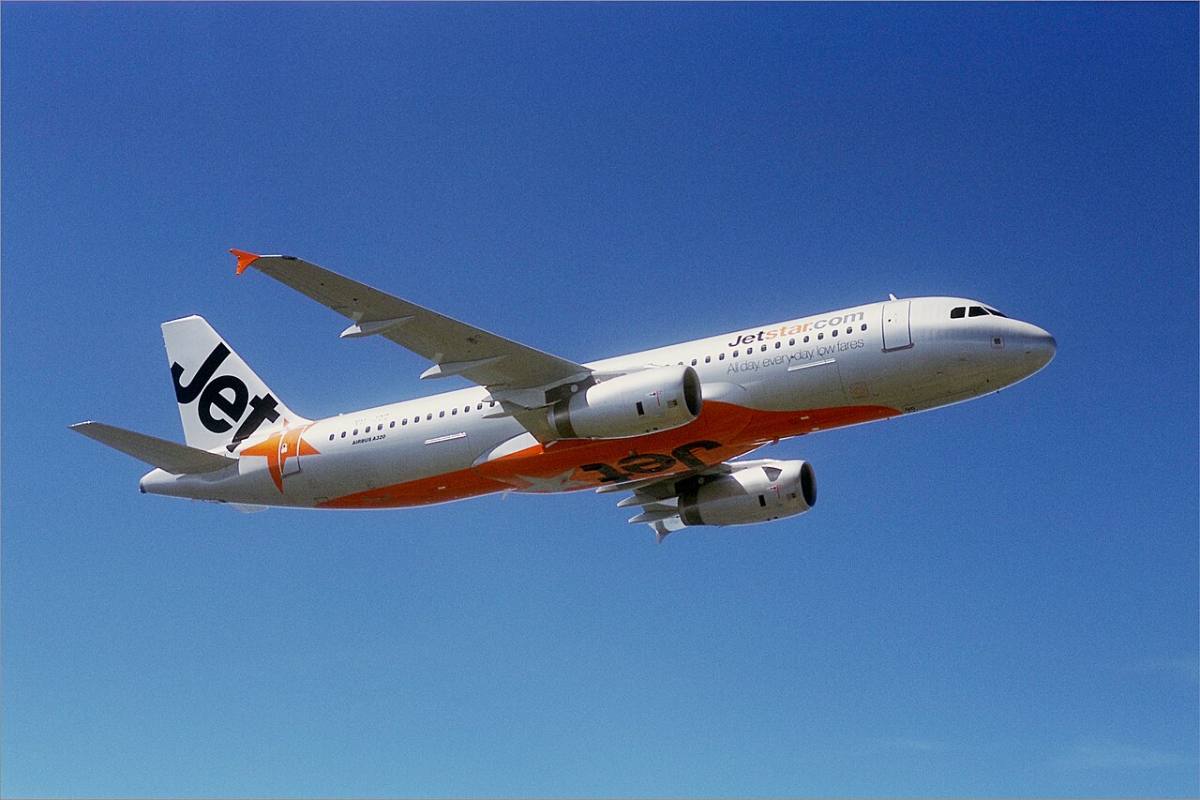
Image credits: Cover photo: United Airbus A320 N464UA by Glenn Beltz, CC BY 4.0; Picture in the text: Jetstar Airbus A320 in flight 6768081249.jpg) by Jetstar Airways from Melbourne, Australia, CC BY-SA 2.0. Pictures from Wikimedia Commons.

Share
Keep reading
Related articles
Concorde: How the Supersonic Airliner Flew and Why It Ended
Concorde carried passengers at about twice the speed of sound from 1976 to 2003. Here is the short story of how it began, what it did and why it was retired.
How a Jet Engine Works: Intake to Exhaust
A jet engine pulls in air, squeezes it, burns fuel in it and blasts it out the back. Learn the four stages and why airliners use turbofans.
What a Flight Recorder Records and How It Survives
The so-called black box is really two orange recorders, one for data and one for voices. Learn what they store, how long, how they survive a crash and how they are found.