What a Flight Recorder Records and How It Survives
The so-called black box is really two orange recorders, one for data and one for voices. Learn what they store, how long, how they survive a crash and how they are found.
In this article
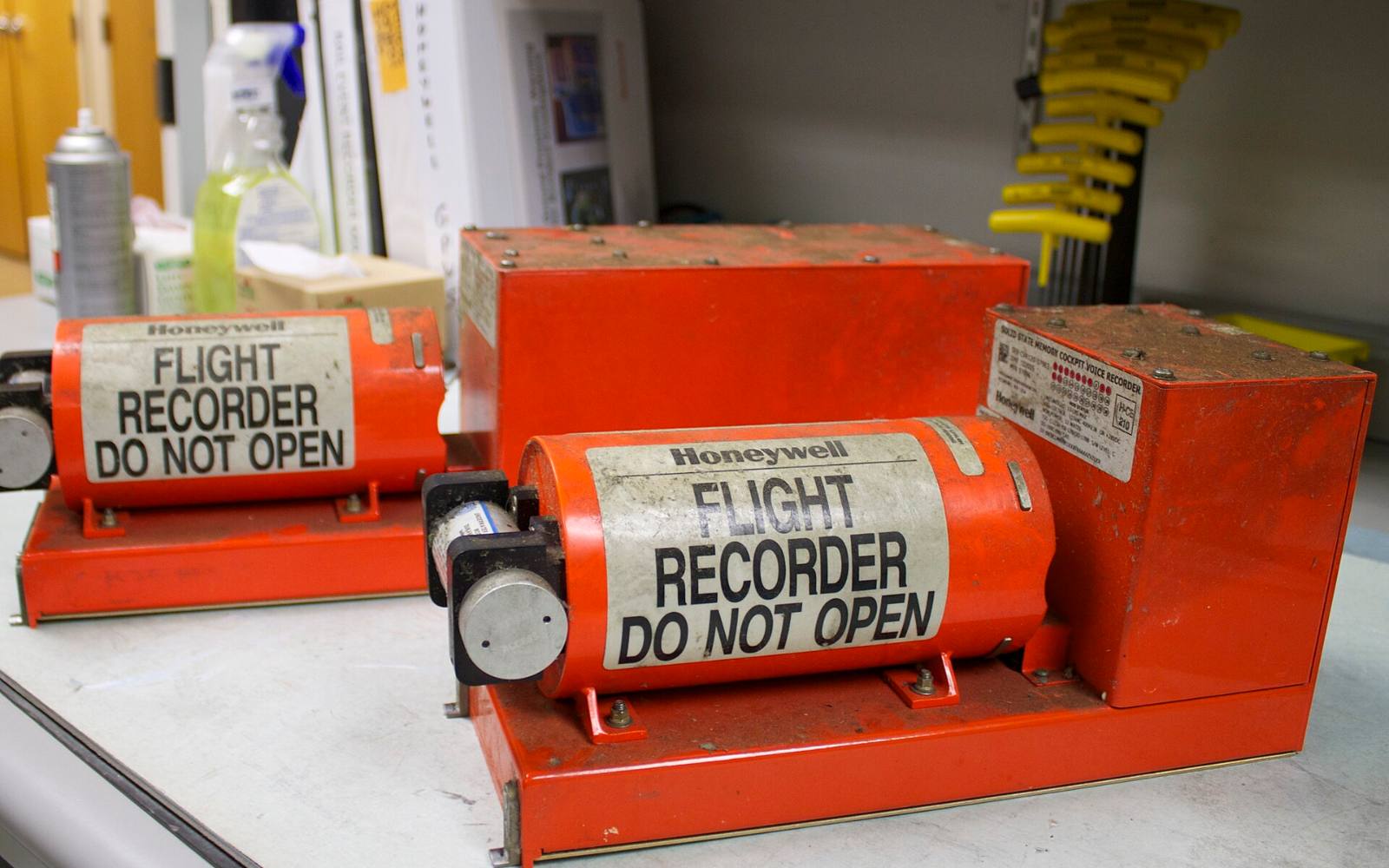
A flight recorder, often called a black box, is not one box and is not black. An airliner carries two recorders: a flight data recorder (FDR) that stores readings from the aircraft, and a cockpit voice recorder (CVR) that stores sound from the flight deck. This article explains what each keeps, how much, how they are built to survive, and where the idea came from.
Two recorders, two jobs
The US National Transportation Safety Board (NTSB) describes the cockpit voice recorder as capturing radio transmissions and cockpit sounds, including the pilots' voices and engine noise, as well as communication with air traffic control. The cockpit area microphone is usually on the overhead panel between the two pilots.
The flight data recorder logs parameters such as altitude, airspeed and heading. The NTSB says newly built aircraft must monitor at least 88 parameters, and some units can record more than 1,000. Wikipedia adds that US rules required only 29 parameters before 2002.
How much they store
Both recorders work as a loop: new recording overwrites the oldest. The NTSB page gives 25 hours of continuous recording for the FDR. For the CVR it gives 30 minutes, or two hours for solid-state digital units, over four channels.
Rules are changing. Wikipedia reports that the European aviation safety agency EASA raised its CVR requirement to 25 hours in 2021, that the US Federal Aviation Administration proposed 25 hours in 2023, and that in January 2024 the NTSB chair urged 25 hours on all existing devices. It also notes a 2024 case in which an Alaska Airlines Flight 1282 recorder was overwritten because it stayed powered after the incident. A longer loop is meant to prevent that.
Why they are orange
The name black box is an old one. Wikipedia says the units must now be bright orange or yellow, with reflective surfaces, so that searchers can spot them in wreckage. They carry the words "Flight recorder do not open" in English, with French on the other side.
Built to survive
Both units are installed in what the NTSB calls the most crash-survivable part of the aircraft, usually the tail. The international standard behind the design is EUROCAE ED-112. According to Wikipedia, its tests include an impact of 3,400 g for 6.5 milliseconds, fire resistance above 1,000 degrees Celsius, static crush, penetration, deep-sea pressure and immersion in seawater and other fluids.
- Impact: 3,400 g for 6.5 milliseconds, roughly the same as a 270-knot impact
- Fire: resistance above 1,000 degrees Celsius
- Other tests: penetration, crushing, deep-sea pressure, fluid immersion
Finding them: the pinger
Each recorder has an underwater locator beacon, usually called a pinger. The NTSB says it switches on when the recorder is immersed in water and sends an acoustic signal at 37.5 kHz that a special receiver can detect from depths down to 14,000 feet. Its battery has a shelf life of six years or more and can run for 30 days after activation.
After an accident in the United States, the NTSB says the recorders are removed from the site and taken to its headquarters in Washington, D.C. for processing. FDR data can be used to build an animation of the flight. The NTSB treats the recordings as one input among many when it works out the probable cause.
Where the idea came from
Wikipedia traces several early efforts. In 1939 the French engineers Francois Hussenot and Paul Beaudouin built a photographic-film recorder. In 1942 Veijo Hietala in Finland made a recorder for fighter test flights, and in 1943 the US Army Air Forces tested a magnetic-wire recorder on a B-17. In wartime Britain, Len Harrison and Vic Husband developed a copper-foil recorder at Farnborough.
The combined data-and-voice idea is linked to David Warren of the Aeronautical Research Laboratories in Melbourne, who conceived it in 1953 and wrote a report in 1954. His team built a prototype flight memory unit, and a combined prototype in 1958. After the 1960 crash of Trans Australia Airlines Flight 538 at Mackay, Australia became the first country to make cockpit voice recording compulsory.
Wikipedia says solid-state recorders became commercially practical in 1990, replacing tape and wire. In the United States, the first rules requiring cockpit voice recorders on four-engine aircraft were set in 1964.
Open questions
After the loss of Malaysia Airlines Flight 370 in 2014 and Indonesia AirAsia Flight 8501 in the same year, people called for live data streaming and ejectable recorders. Wikipedia notes that the NTSB had earlier, in 1999, recommended ejectable second recorders. Whether and when such changes become standard is up to regulators; this article does not predict it.
Sources
Image credits: Cover photo: NTSBAsiana214FDRAndCVR by NTSB, Public domain. Pictures from Wikimedia Commons.

Share
Keep reading
Related articles
How a Jet Engine Works: Intake to Exhaust
A jet engine pulls in air, squeezes it, burns fuel in it and blasts it out the back. Learn the four stages and why airliners use turbofans.
Why Airliners Cruise at About 35,000 Feet
Airliners usually cruise between 31,000 and 38,000 feet. See why thin air, engine behaviour and weather make that the sweet spot, and what limits go higher.
How Airplanes Stay in the Air: The Four Forces of Flight
Every flight comes down to four forces: lift, weight, thrust and drag. See what each one does, how pilots change the balance for takeoff, cruising and landing, and why engines do not lift the plane.