How Automatic Gearboxes Work: Torque Converter and Gears
A conventional automatic gearbox joins the engine to planetary gears through a fluid-filled torque converter and picks ratios with hydraulic clutches. Here is how each part works.
In this article
A conventional automatic gearbox changes gear without a clutch pedal by using three ideas together: a fluid-filled torque converter in place of a clutch, planetary gear sets that make the different ratios, and hydraulic pressure that decides which gears are engaged. This article explains each part in plain terms. Other automatic designs, such as CVTs and dual-clutch gearboxes, work differently and are covered briefly at the end.
Why a car needs a gearbox at all
A petrol or diesel engine works well only inside a band of speeds. A gearbox lets the wheels turn at a very different speed from the engine: a low gear gives strong pulling force for starting, and a high gear lets the engine turn slowly at cruising speed. A manual gearbox needs a clutch pedal to disconnect the engine while the driver swaps gears. A conventional automatic does both jobs on its own.
The torque converter: a clutch made of fluid
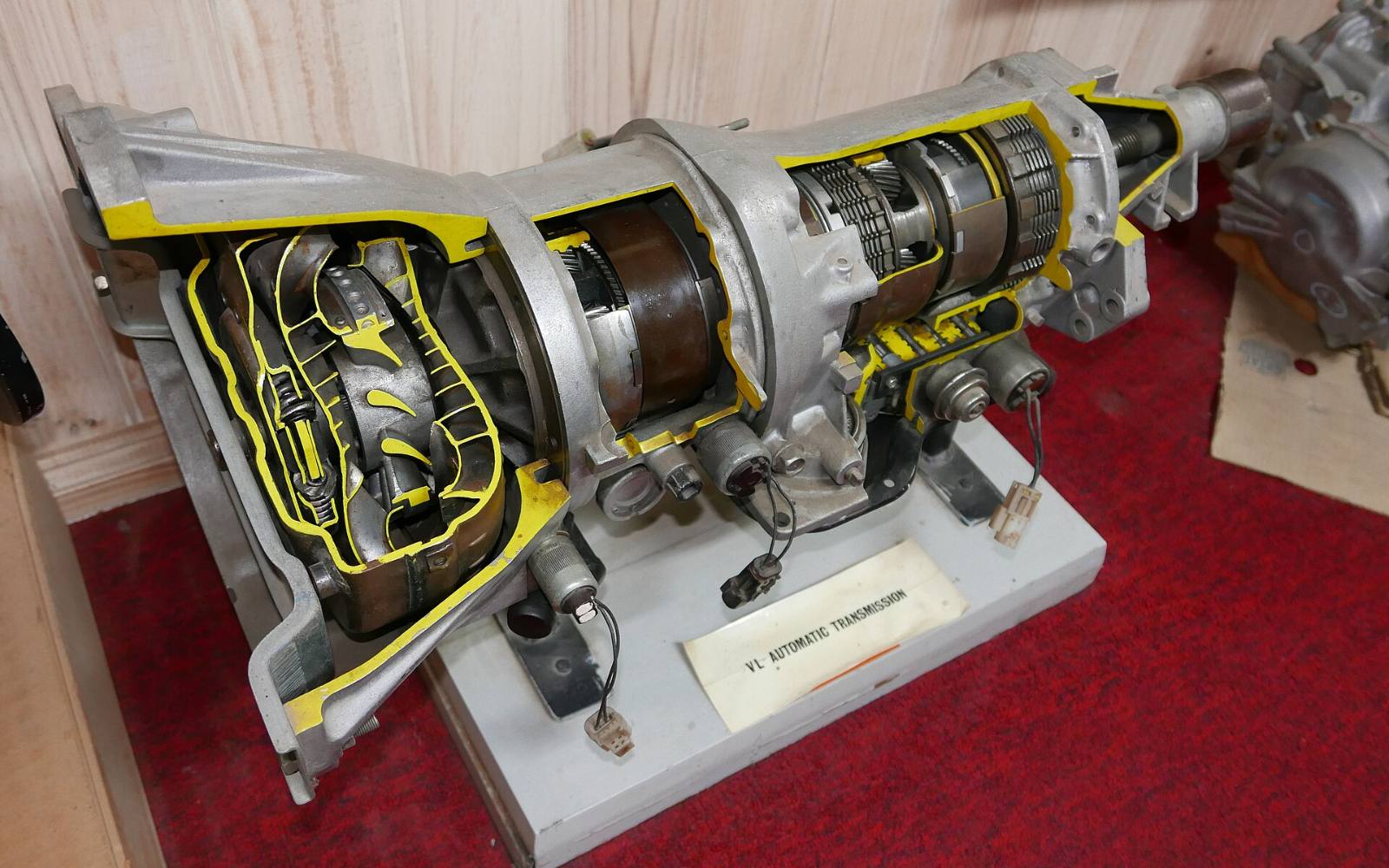
Between the engine and the gearbox sits a torque converter, a doughnut-shaped housing filled with transmission fluid. It has three main parts, described on Wikipedia's torque converter page.
- Impeller: the input side, spun by the engine. Its vanes throw fluid outward.
- Turbine: the output side, connected to the gearbox. The moving fluid pushes it round.
- Stator: a small wheel between the two. It redirects fluid coming back from the turbine so that it helps the impeller instead of fighting it. It sits on a one-way clutch, so it can turn forward but not backward.
A simpler fluid coupling has only the first two parts and cannot increase torque. The stator is what allows a converter to multiply torque when the car moves off. According to Wikipedia, typical car converters multiply torque by about 1.8 to 2.5 times at stall, which is the moment when the engine is working but the turbine is held still. As the car speeds up, the multiplication falls. When the turbine reaches roughly 90% of the impeller speed, the unit acts like a plain fluid coupling.
Because the link is fluid, the engine keeps running when the car is stopped in gear. This is why an automatic can idle at a red light with the brake pressed and does not stall.
Fluid always slips a little, which wastes fuel. Many converters therefore contain a lock-up clutch that joins impeller and turbine mechanically at cruising speed. Wikipedia says such clutches became nearly universal in cars after returning in the late 1970s for fuel economy.
Planetary gear sets: many ratios in a small space
Instead of pairs of gears on parallel shafts, most automatics use planetary gear sets. One set has four kinds of part, according to Wikipedia's planetary gear page: a central sun gear, two to four planet gears that mesh with it, a carrier that holds the planets, and an outer ring gear with teeth on the inside.
The trick is to hold one part still while another is driven. With the ring gear held and the sun gear as input, the carrier turns more slowly than the sun, giving a reduction. Hold a different part and the same set gives a different ratio, or reverses direction. Several sets can be placed one after another in a single housing. The same page names compound designs used in automatics, including the Simpson set with three forward gears and the Lepelletier set with six.
Clutches and bands choose the gear
What holds a part still? Band brakes that clamp a drum, and multi-plate clutches made of friction discs that alternate with steel plates. Hydraulic pistons squeeze them together or let them go. YourMechanic's explainer says the discs grip the steel plates gradually, which is why a gear change feels smooth. One-way sprag clutches also carry torque in normal shifts and release by themselves when the next gear takes over, as noted by Wikipedia, so the timing of the other clutches is less critical.
Hydraulics and the control unit
A pump, driven by the converter housing and so turning at engine speed, draws fluid from the sump and pressurises it. A valve body sends that pressure to the right clutches and bands. Older gearboxes used a governor linked to the output shaft, which let in more fluid as the car went faster, and a vacuum modulator that sensed engine load. Newer ones use solenoids controlled by a transmission or engine control computer, which reads speed sensors and the throttle position.
Since the pump runs off the engine, there is no pressure when the engine is off. Wikipedia gives this as the reason most automatic cars cannot be push-started.
A short history
- 1940 model year: General Motors' Hydra-Matic, using a fluid coupling and three planetary sets for four forward speeds, became the first mass-produced automatic.
- 1948: Buick's Dynaflow was the first automatic with a torque converter.
- 1964: GM's Turbo Hydramatic used a converter and helped fix the P-R-N-D-L selector layout.
- 1989: Nissan's Jatco 5R01 was the first electronically controlled five-speed.
- 2002 and 2007: ZF's six-speed in the BMW 7 Series and Toyota's AA80E mark the first six- and eight-speed units, with a ten-speed in the 2017 Lexus LC.
These dates come from Wikipedia's automatic transmission page, which itself notes that the claim for an earlier 1904 gearbox is unverified.
Other types of automatic
- CVT: a continuously variable transmission with no fixed gears, usually two pulleys joined by a belt or chain.
- Dual-clutch (DCT): two clutches, one for odd gears and one for even, so the next gear is ready before the change.
- Automated manual (AMT): a manual gearbox where the clutch and shifting are done by actuators.
YourMechanic notes that transmission fluid lubricates and cools the parts, so low or burnt fluid is a common warning sign. For any actual fault or service interval, follow the car's own manual.
Sources
- Automatic transmission, Wikipedia
- Torque converter, Wikipedia
- Planetary gear, Wikipedia
- How an Automatic Transmission Works, YourMechanic
Image credits: Cover photo: 4-speed Jatco E4N71B automatic transmission 2015-08-29.jpg) by OSX, Public domain. Pictures from Wikimedia Commons.
Share
Keep reading
Related articles
How an Automatic Transmission Shifts Gears Itself
An automatic gearbox uses a fluid-filled torque converter instead of a clutch pedal and planetary gears chosen by hydraulic pressure. Here is how the parts work together.

Countersteering: How Motorcycles and Bikes Turn
To turn right on a bike or motorcycle, a rider first nudges the bars left. Here is why that starts the lean, what keeps two-wheelers upright and where the science is still debated.
How a Motorcycle Quickshifter Works Without the Clutch
A quickshifter lets a rider change gear without the clutch by cutting engine power for a few milliseconds. Here is how the sensor, the ECU and the gearbox work together.