How a Motorcycle Quickshifter Works Without the Clutch
A quickshifter lets a rider change gear without the clutch by cutting engine power for a few milliseconds. Here is how the sensor, the ECU and the gearbox work together.
In this article
A quickshifter lets a rider change gear without pulling the clutch lever. A sensor notices that the rider is pushing the gear lever, and the engine's computer, the ECU, briefly cuts the ignition or the fuel. For a few milliseconds the engine stops pushing the gearbox, the next gear slides in, and power returns. This article explains each step, the difference between upshift-only and two-way systems, and the limits.
Why changing gear normally needs a clutch
In a motorcycle gearbox, gears are held against each other by the force of the engine. Under power, the teeth that transmit that force are pressed hard together, so the shift mechanism cannot easily move them. A conventional upshift deals with this in several steps: pull in the clutch, close the throttle, change gear, then release the clutch and open the throttle. Honda's Indian two-wheeler site notes that this lets engine speed drop at each change.
The quickshifter removes the need for the first two steps. Its job is to take the load off the gearbox for just long enough that the lever can move the gear.
Step 1: the sensor
Most systems put a sensor in or on the shift rod, the link between the lever and the gearbox. RideApart explains that many kits replace the stock rod with one that holds a mechanical sensor wired to the ECU. Other designs use a positional sensor that reads the lever's movement, and some use pressure sensors in the transmission. Honda describes a sensor that measures how hard the rider presses the lever. All of these do the same job: they tell the ECU that a gear change is about to happen.
Step 2: the cut
When the ECU receives the signal, it briefly interrupts the engine's output by cutting the ignition, the fuel, or both, depending on the design. RideApart says this can last as little as 15 milliseconds. Honda says only that the cut lasts a few milliseconds and that factory calibration times it precisely. With the drive torque momentarily gone, the gearbox is unloaded, so the next gear can engage before power comes back.
Because the ECU does the work, the rider does not need to touch the clutch or roll off the throttle. Some aftermarket kits let the owner set the cut time for each gear.
Upshift only and two-way systems
- Upshift-only: handles changes up the gearbox under acceleration. The clutch is still needed for downshifts, as Honda points out.
- Bi-directional (two-way): handles both directions. For a downshift, an auto-blipper briefly opens the throttle electronically so the engine speed matches the speed the gearbox needs, as Honda describes.
- BMW's Gear Shift Assistant Pro is given by RideApart as an example of a system that handles both.
Matching the speeds is the same thing a rider does by blipping the throttle during a manual downshift, which is why two-way systems need an electronically controlled throttle to do it for you.
What it does and does not do
Honda lists the benefits as less rider effort on repeated gear changes, more stability when shifting mid-corner and uninterrupted acceleration for overtakes and corner exits. RideApart adds that the system does not make a poor rider better, and that riders still need to shift deliberately.
- It works best under moderate to hard acceleration, according to Honda.
- It is not well suited to stop-and-go traffic or low speeds, according to RideApart.
- It does not replace the clutch for pulling away or stopping.
Where you will see it
Recent launches show how common the feature has become on performance motorcycles. Suzuki's published specification for the GSX-10R sportbike, unveiled at EICMA 2026, lists a bi-directional quick shift, and Moto Guzzi's new The Trip lists a six-speed gearbox with quick shifter. BMW's M 1000 RS lists a shift assistant that allows clutchless up and down shifts.
Sources
- Ask RideApart: How Do Motorcycle Quick Shifters Work?, RideApart
- What Is a Quick Shifter in Motorcycles and How Does It Work?, Honda 2Wheelers India
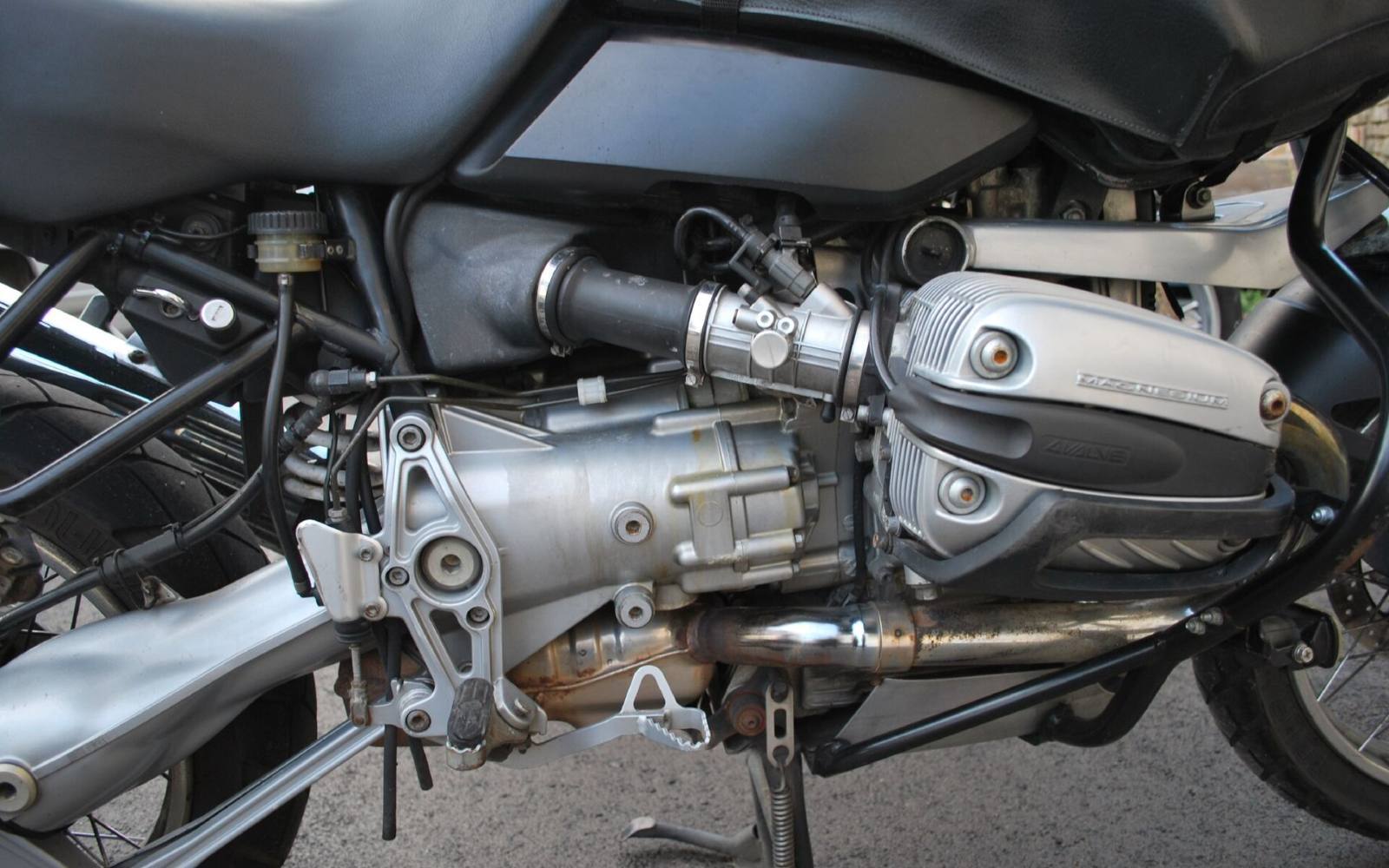
Image credits: Cover photo: BMW R1150GS engine and gearbox by Dimitri, CC BY 2.0. Pictures from Wikimedia Commons.

Share
Keep reading
Related articles
How an Automatic Transmission Shifts Gears Itself
An automatic gearbox uses a fluid-filled torque converter instead of a clutch pedal and planetary gears chosen by hydraulic pressure. Here is how the parts work together.
Royal Enfield Himalayan 750 Unveiled: Specs and Colours
Royal Enfield unveiled the Himalayan 750 at EICMA 2026 with a new 743cc twin. Official specifications, colours and UK prices, plus what is not yet known for India.
Suzuki GSX-10R Unveiled at EICMA 2026: Specs and Dates
Suzuki has unveiled the GSX-10R, a 999cc inline-four sportbike, and the SV-7S naked bike at EICMA 2026. Sales start from spring 2027; no prices have been announced.