How a Turboprop Engine Turns a Jet Core Into Propeller Power
A turboprop is a gas turbine that spends nearly all its energy spinning a propeller through a gearbox. Here is how it works and why short routes use it.
In this article
A turboprop engine is a gas turbine, the same kind of core found in a jet engine, but built to turn a propeller instead of pushing out a fast jet of exhaust. Almost all of its thrust comes from the propeller. This makes turboprops efficient at the moderate speeds and short distances flown by regional airliners, cargo planes and many business aircraft.
The gas generator at the core
Like a basic turbojet, a turboprop has a compressor, a combustor (burner) and a turbine. Air is squeezed by the compressor, mixed with fuel and burned, and the hot gas expands through turbine stages. NASA's Glenn Research Center describes it as a turbojet core with an extra turbine behind the main one. That core is called the gas generator.
In a jet engine most of the leftover energy leaves as a fast exhaust jet. In a turboprop, extra turbines take almost all of that energy and use it to drive a shaft. SKYbrary notes that the turbines extract almost all the energy from the exhaust. Some of it powers the compressor, and the rest drives the propeller.
Why there is a gearbox
A turbine spins very fast and with relatively little twisting force. A propeller works best turning slowly with a lot of twisting force. A reduction gearbox sits between the two and converts one into the other. Wikipedia describes it as turning the turbine's high-speed, low-torque output into the low-speed, high-torque input a propeller needs.
Two layouts: fixed shaft and free turbine
- Fixed shaft: the same shaft drives the compressor and, through the gearbox, the propeller. The TPE331 is given as an example.
- Free turbine: a separate power turbine drives its own shaft that runs through the middle of the compressor shaft. The propeller can turn independently of the gas generator. The Pratt & Whitney Canada PT6 is an example.
SKYbrary calls the second type a free turbine engine. Wikipedia adds that this layout can help protect the core if the propeller is damaged.
How much thrust comes from where
A propeller moves a large mass of air and changes its speed only slightly. NASA says this is an efficient way to make thrust. The exhaust that is left over is slow and adds little. Wikipedia puts the exhaust's share at about 10% of thrust. Together, the propeller thrust plus the core's small thrust make up the total.
Wikipedia also says turboprops have bypass ratios of roughly 50 to 100, because the air passing through the propeller is so much larger than the air through the core.
The propeller itself
Most turboprops use a constant-speed propeller, which changes the blade angle (pitch) so the engine can stay at its best speed. According to Wikipedia, the same pitch control allows reverse thrust on the ground and feathering, which turns the blades edge-on to the airflow after an engine failure to cut drag.
Where turboprops fit
Propellers lose efficiency as their blade tips near the speed of sound. For that reason, NASA says turboprops suit low-speed aircraft such as cargo planes and small commuter aircraft, while high-speed transports use high-bypass turbofans. Wikipedia says turboprops generally fly below about Mach 0.6 to 0.7. SKYbrary says they are most efficient below Mach 0.6, burn less fuel per seat-mile and need much less runway than similar-sized jets.
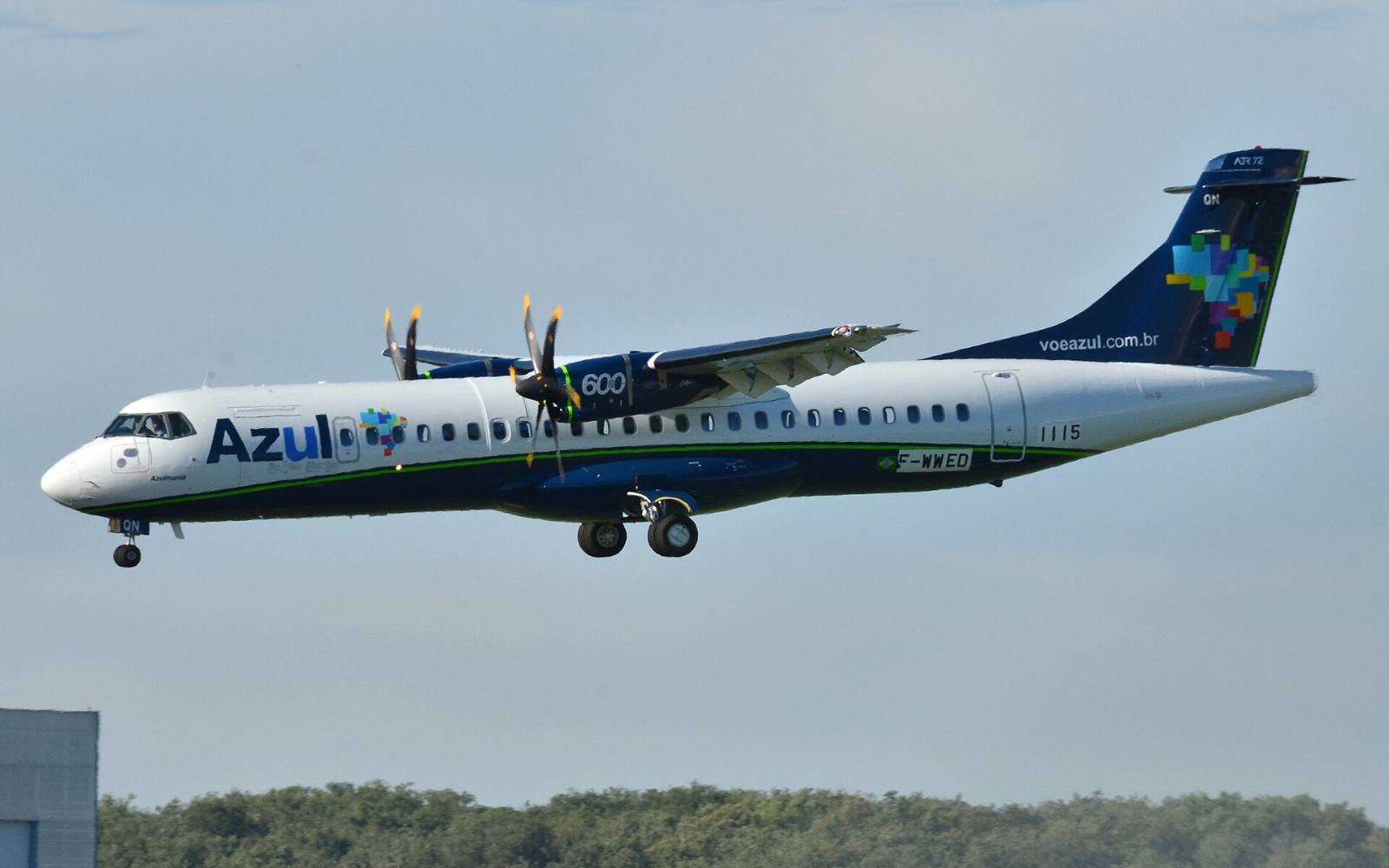
Wikipedia adds that modern turboprop airliners fly at about the speed of small regional jets while using about two-thirds of the fuel per passenger. The ATR 42 and 72 are described as the most widespread turboprop airliners, with 950 in service in 2017, and the Bombardier Dash 8 Q400 had 506 in service in the same year. The Pilatus PC-12 is another SKYbrary example.
A short history
- 1929: Hungarian engineer György Jendrassik patented what Wikipedia calls the first turboprop design.
- 20 September 1945: a Gloster Meteor test aircraft with Rolls-Royce engines became the first turboprop-powered aircraft to fly.
- 16 July 1948: the Vickers Viscount first flew. It was the first turboprop airliner to enter production and sell in large numbers.
- December 1963: the first PT6 was delivered, for the Beechcraft 87.
Turboprop versus turboshaft
A turboshaft engine is very similar but drives a transmission instead of a propeller, as in helicopters. SKYbrary notes that many engines come in both versions, and a turboprop must be built sturdier to handle propeller loads.
Sources
Image credits: Cover photo: ATR 72-600 Azul F-WWED - MSN 1115 10515838574_F-WWED_-_MSN_1115_(10515838574).jpg) by Laurent ERRERA from L'Union, France, CC BY-SA 2.0. Pictures from Wikimedia Commons.
Share
Keep reading
Related articles
How a Car Cooling System Keeps an Engine at Temperature
A pump, radiator, thermostat and pressurised coolant work together to shed engine heat. Here is what each part does and why the mix and pressure matter.
Diesel vs Petrol Engines: Spark or Squeeze?
Petrol engines light their fuel with a spark; diesel engines light it by squeezing air until it is hot. Here is what that one difference changes.
How a Turbocharger Works: Exhaust Power Made Useful
A turbocharger uses hot exhaust gas to spin a turbine that pushes extra air into an engine. Learn the parts, the lag, and where the idea came from.