How a Turbocharger Works: Exhaust Power Made Useful
A turbocharger uses hot exhaust gas to spin a turbine that pushes extra air into an engine. Learn the parts, the lag, and where the idea came from.
In this article
A turbocharger is a device that uses the engine's own exhaust gas to push more air into its cylinders. More air lets the engine burn more fuel in each cycle, so a small engine can make the power of a larger one. This article explains the parts, why there is sometimes a delay before the power arrives, and where the invention came from.
Two fans on one shaft
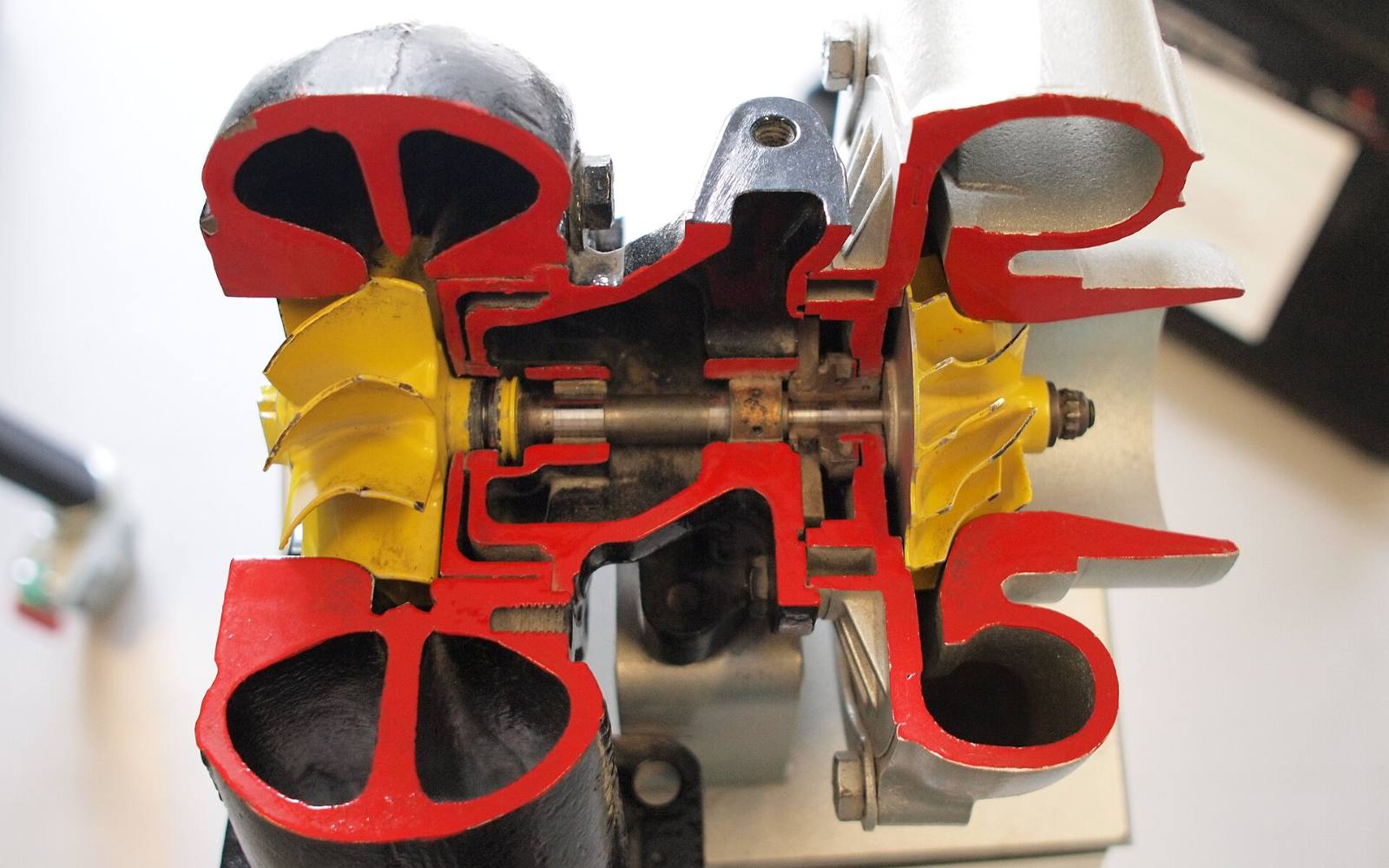
At its core, a turbocharger is two small fans joined by a shaft. One fan, the turbine, sits in the exhaust stream. Hot gas leaving the engine spins it, and according to the Wikipedia article on the subject, turbine speeds can reach as much as 250,000 revolutions per minute.
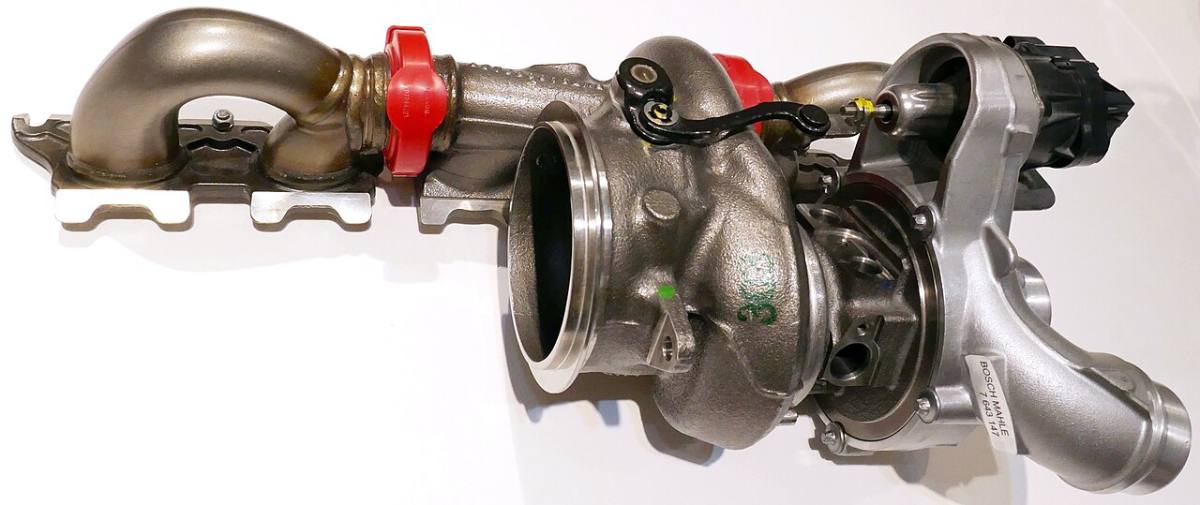
The other fan, the compressor, sits in the air intake. Because it is on the same shaft, it spins whenever the turbine does. It draws in outside air, squeezes it, and feeds it towards the engine. The shaft runs on a bearing inside a centre housing, and a lighter shaft helps the unit respond faster.
Nothing here is driven by the crankshaft. The turbo recovers energy that would otherwise leave through the tailpipe as heat and pressure.
Why more air means more power
An engine makes power by burning fuel with air. Fuel needs a matching amount of oxygen, so the air supply limits how much fuel can be burned usefully. Pushing in compressed air packs more oxygen into the same cylinder volume. The engine control system adds more fuel to match, and each combustion stroke releases more energy.
This is why manufacturers use turbos to fit smaller engines. Explain That Stuff says a well-working turbo may save up to 10 percent of fuel, because a smaller, lighter engine can replace a larger one. A turbo does not create energy from nothing: extra power still needs extra fuel when the driver asks for it.
The intercooler and the wastegate
Squeezing air heats it, and hot air is less dense, which cancels part of the benefit. Many turbocharged engines therefore pass the compressed air through an intercooler, a radiator-like unit that cools it before it reaches the cylinders. Cooler air is denser and carries more oxygen.
A turbo can also make more pressure, called boost, than an engine can safely take. A wastegate is a valve that lets some exhaust bypass the turbine, which limits the boost.
Turbo lag
Turbo lag is the pause between pressing the accelerator and feeling the extra power. The turbine must first be spun up by exhaust gas, and at first there is little of it. A related issue is the boost threshold: at low engine speeds there is not enough exhaust flow to give much boost at all.
Engineers reduce lag in several ways. They make the rotating parts lighter, use twin-scroll or variable-geometry turbines that adjust to the gas flow, or add electric assistance. Explain That Stuff names Garrett's E-Turbo and BorgWarner's eBooster as electrically assisted designs under development.
- Lighter turbine and shaft, so it speeds up sooner
- Twin-scroll and variable-geometry turbines that adapt to the gas flow
- Electric motors that spin the turbo before exhaust flow builds
Turbocharger or supercharger?
A supercharger also forces air into the engine, but it is driven by the crankshaft through a belt or gears. It therefore responds immediately, with no lag, but it takes some of the engine's own power to run. A turbocharger uses waste exhaust energy instead, which is why it is often described as more efficient, with a delay as the trade-off.
A short history
Forced induction is older than the turbo. According to Wikipedia, Gottlieb Daimler patented a gear-driven air pump in 1885. The turbocharger itself is usually credited to the Swiss engineer Alfred Büchi, who worked at Sulzer and filed a patent in 1905. His first prototype was finished in 1915 and was aimed at aircraft engines that lose power at high altitude, but it was not reliable enough for production.
In 1917 the US National Advisory Committee for Aeronautics tested a turbocharged Liberty L-12 aircraft engine on Pikes Peak, and it showed no power loss up to 4,250 metres. The first commercial turbocharger was delivered in June 1924, and in 1925 Büchi's turbochargers raised the output of a ten-cylinder diesel from 1,300 to 1,860 kilowatts.
For cars, Wikipedia names the 1962 Chevrolet Corvair Monza and the Oldsmobile Jetfire as the first turbocharged production models.
Drawbacks to know about
A turbo adds parts, heat and pressure. Explain That Stuff notes that this extra complexity raises maintenance costs and the chance of failure, and that turbocharged engines generally do not last as long. It also cites a 2013 Consumer Reports study which found small turbo engines delivered worse fuel economy than their official figures suggested. The result depends on how the car is driven: asking for boost uses extra fuel.
Where turbos are used
Turbochargers fit both petrol and diesel engines. Explain That Stuff lists cars, trucks, ships and buses as users. Cummins, which makes diesel engines and turbochargers, also publishes an overview of how the technology works on its own site.
Sources
Image credits: Cover photo: Sectioned Garrett AiResearch turbocharger by Tommi Nummelin, CC BY-SA 3.0; Picture in the text: Turbocharger 3 by Tiia Monto, CC BY 4.0. Pictures from Wikimedia Commons.


Share
Keep reading
Related articles
How a Hybrid Car Works: Engine, Motor and Battery Explained
A hybrid pairs a petrol engine with an electric motor and a battery that charges itself while you drive. Here is what each part does, how braking recovers energy, and why it saves fuel.
What Regenerative Braking Does in Hybrids and EVs
Regenerative braking turns the motor into a generator while slowing, sending some energy back to the battery instead of wasting it as heat.
How ABS Brakes Stop Wheels From Locking Up
Anti-lock brakes release and reapply pressure many times a second so a wheel keeps turning. See the four parts, what the pedal pulse means and where ABS falls short.