How a 12-Volt Car Battery Works: Lead-Acid Basics
Most petrol and diesel cars start on a lead-acid battery. Learn how its plates and acid store energy, why cold weather matters, and what sulfation does.
In this article
A conventional car's 12-volt battery is a lead-acid battery. Its job is short and heavy: deliver a large burst of current to turn the starter motor, then rest while the alternator recharges it. It works through a reversible chemical reaction between lead plates and sulfuric acid, a design first invented in 1859 by Gaston Planté as the first rechargeable battery.
Inside the battery
Each cell holds two kinds of plate bathed in a sulfuric acid solution called the electrolyte. The negative plate is lead. The positive plate is lead dioxide. A single cell makes about 2.1 volts when fully charged. A 12-volt battery links six cells in series, which adds up to about 12.6 volts at rest (6 times 2.1).
What happens when it discharges
When you start the engine, both plates react with the acid and turn into lead sulfate. The negative plate releases electrons that flow through the starter motor and back to the positive plate. The acid is used up as the reaction proceeds, so the liquid becomes weaker and closer to plain water.
The overall reaction, in chemical shorthand, is Pb + PbO2 + 2H2SO4 giving 2PbSO4 + 2H2O. Because the acid strength falls as the battery empties, a hydrometer, which measures the density of the liquid, can estimate how charged a flooded battery is.
How it recharges
While the engine runs, the alternator pushes current backward through the cell. That reverses the reaction and turns the lead sulfate back into lead, lead dioxide and acid. Overcharging is a problem: it splits water in the electrolyte into hydrogen and oxygen gas, which is why flooded batteries can lose water and why they are vented.
A starter battery is built for bursts
According to Battery University, a starter battery is designed to crank an engine with a brief, high-power load of around a second. It uses many thin plates of sponge-like lead, which gives a large surface area and low internal resistance. That is the opposite of a deep-cycle battery, which has thicker plates and is built to be emptied often. Battery University says a starter battery discharged completely lasts only about 12 to 15 cycles, against 150 to 200 for a deep-cycle type.
Cold cranking amps
You will see a number marked CCA on a battery label. Cold cranking amps are a rating of how much current the battery can deliver in cold conditions. Under the SAE J537 test, as Battery University describes it, the battery supplies its rated current for 30 seconds at minus 18 degrees Celsius, with its voltage staying above 7.2 volts. A second rating, reserve capacity, is the number of minutes the battery can supply a steady 25 amps.
Why batteries wear out
- Sulfation: lead sulfate that is not converted back during charging forms hard crystals that reduce the plate area. It builds up when a battery sits at low charge. Battery University says it can be reversed if treated in time, while Wikipedia says there is no independently verified way to reverse it, so prevention by recharging fully is the safe approach
- Corrosion: the positive plate's grid corrodes over time, and this damage is permanent
- Heat: Battery University says the best operating temperature is 25 degrees Celsius, and every 8 degrees above that roughly halves battery life
- Cold: a poorly charged battery has weaker acid, which raises the risk of freezing
Types you may meet
- Flooded: liquid acid around the plates, sometimes with caps for topping up with water
- AGM (absorbent glass mat): the acid is soaked in a glass fibre mat; sealed, and can be mounted in any orientation
- Gel: silica is mixed into the acid to make a gel that evaporates less
Sources
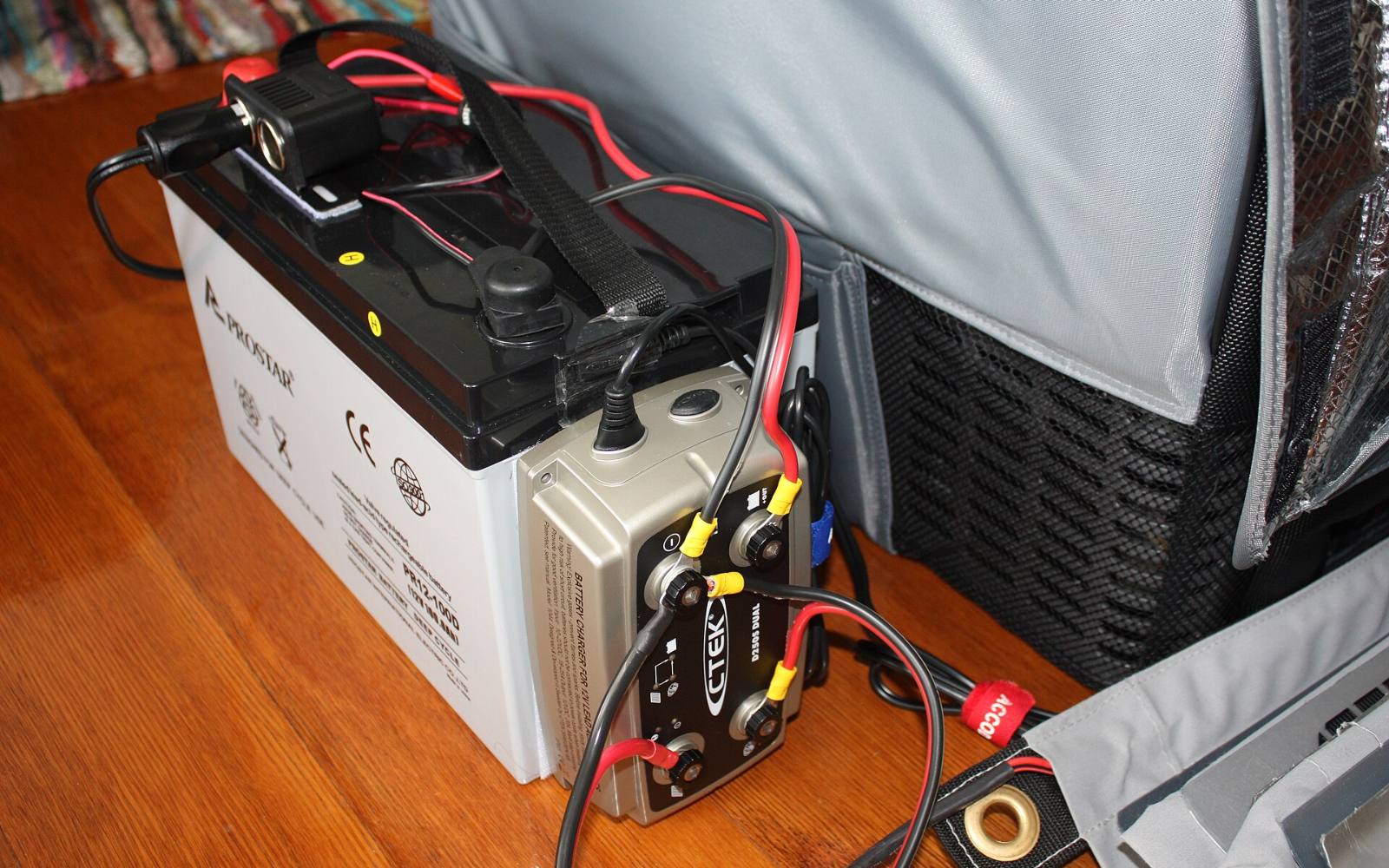
Image credits: Cover photo: Auxiliary Battery & CTEK charger by Stephan Ridgway from Brisbane, Australia, CC BY 2.0. Pictures from Wikimedia Commons.

Share
Keep reading
Related articles
mAh vs Wh: How to Read a Battery's Capacity
mAh counts electric charge while Wh counts energy. Learn the conversion, why voltage matters, and why watt-hours are the figure airlines ask about.
How Car Suspension Works: Springs, Dampers, Bars
Car suspension links the wheels to the body with springs, dampers and bars. See what each part does, how common layouts differ and the history behind them.
How Tyre Pressure Monitoring Systems Work
TPMS warns you when a tyre is low. See how direct sensors in the wheel differ from indirect systems that watch wheel speed, and what each can miss.