How Tyre Pressure Monitoring Systems Work
TPMS warns you when a tyre is low. See how direct sensors in the wheel differ from indirect systems that watch wheel speed, and what each can miss.
In this article
A tyre pressure monitoring system, or TPMS, turns on a dashboard warning light when one or more tyres are well below the recommended pressure. There are two designs. A direct system measures pressure with a sensor in each wheel. An indirect system measures nothing about pressure at all: it infers a soft tyre from how fast the wheel spins.
Direct TPMS: a sensor in every wheel
A direct system places a battery-powered pressure sensor in each wheel, often attached to the valve. It sends readings by radio to a central unit in the car, so it can say which tyre is low. Wikipedia notes that the sensor battery limits the sensor's life and that on most factory sensors the battery cannot be replaced, so a dead battery means taking the tyre off the wheel. Some designs are powered wirelessly like RFID tags and avoid that limit.
Indirect TPMS: reading wheel speed
An indirect system reuses the wheel-speed sensors that the anti-lock braking and stability systems already have. A tyre with low pressure has a slightly smaller rolling diameter, so it turns a little faster than the others over the same distance. First-generation systems compare the wheel speeds with each other. Second-generation systems analyse the vibration pattern of each wheel and can detect low pressure in up to all four tyres.
Because it only compares speeds, an indirect system cannot show an actual pressure number. After you adjust the tyres, you reset it, and it relearns its reference values over roughly 20 to 60 minutes of driving, according to Wikipedia.
When does the light come on?
In the United States, rule FMVSS 138 requires a warning when a tyre is 25 per cent or more below the pressure on the vehicle's placard. The system covers cars up to 10,000 lb gross weight. The rule was phased in from October 2005 and applied to all new such vehicles from September 2007. In the European Union, TPMS became mandatory on new passenger cars from 1 November 2014. The Wikipedia article does not cover India.
A 25 per cent drop is large. If the placard says 32 psi, the light would be expected only when a tyre falls to about 24 psi or below. That is why checking pressure with a gauge still matters.
What it cannot do
- It cannot detect sudden damage such as a tyre failing after hitting a kerb or pothole
- Indirect systems can be less accurate, and temperature changes can shift pressure by about as much as the detection thresholds
- On some direct systems the unique ID in each sensor's signal can be used to track a vehicle unless the signals are encrypted (Wikipedia)
- Most systems do not work well on heavy vehicles above 26,000 lb
Wikipedia also notes that a 2018 UNECE field study of 1,470 vehicles found no difference in effectiveness between direct and indirect systems.
Why pressure matters
Tyres lose some air on their own, roughly 20 to 60 kPa (3 to 9 psi) a year or about 10 per cent of initial pressure, according to Wikipedia. The US fueleconomy.gov site says mileage falls by about 0.2 per cent for every 1 psi drop in the average pressure of all tyres, and that proper inflation improves mileage by about 0.6 per cent on average, and up to 3 per cent in some cases. It adds that properly inflated tyres are safer and last longer.
Which number to use
Fueleconomy.gov says the recommended pressure is usually on a sticker in the driver's door jamb or glove box and in the owner's manual. The maximum pressure moulded into the tyre sidewall is not the target. Check pressure when the tyres are cold, and reset the system as your manual describes.
Sources
- Tire-pressure monitoring system, Wikipedia
- Keeping Your Car in Shape, fueleconomy.gov (US Department of Energy)
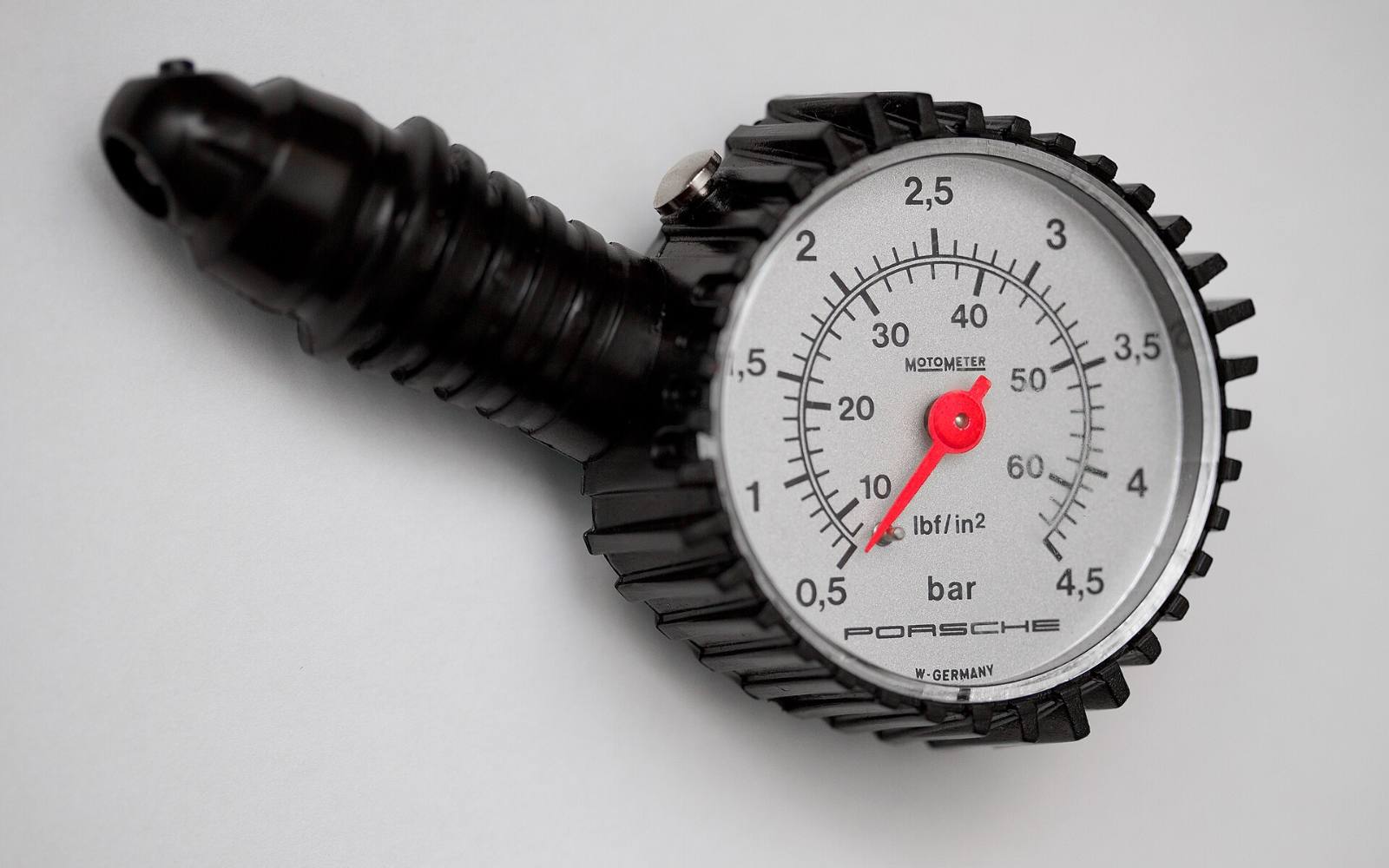
Image credits: Cover photo: Porsche Tire Pressure Gauge 9207945919.jpg) by Antti, CC BY 2.0. Pictures from Wikimedia Commons.
Share
Keep reading
Related articles
How a Car Airbag Senses a Crash and Inflates in Time
An airbag must decide, fire and fill within about 50 milliseconds. Here is how crash sensors, a control module and a gas inflator do that, and what airbags can and cannot do.
How Electronic Stability Control Keeps a Car on Course
Electronic stability control compares where you steer with where the car goes and brakes single wheels to correct a skid. Here is how it works, its history and limits.
How to Read the Numbers on a Car Tyre
A tyre sidewall code such as 205/55 R16 91V gives width, height, rim size, load limit and speed rating. This guide explains each part and the date code.