What Quantum Computers Are For, and What They Cannot Do
Quantum computers use qubits, superposition and interference to attack a narrow set of problems. What they may be good at, why errors hold them back, and what that means for encryption.
In this article
A quantum computer is not a faster version of the laptop on your desk. It is a different kind of machine that uses quantum physics to handle a narrow set of problems, such as simulating molecules or breaking certain kinds of encryption, far more efficiently than ordinary computers can. The US standards body NIST says quantum computers will not replace familiar classical computers but could work alongside them. This article explains the basic ideas, what the machines may be for, and the large obstacle that remains: errors.
Bits and qubits
An ordinary computer stores information in bits, each of which is 0 or 1. A quantum computer uses qubits. A qubit can be 0, 1, or a superposition of both, which in plain terms means it carries two numbers that set the probability of reading 0 or 1 when it is measured. Qubits can also be entangled, meaning their states are linked and cannot be described one by one.
NIST gives a simple picture of the scaling: two qubits can hold four combinations of 0 and 1, three hold eight, four hold sixteen, and each extra qubit doubles the count. That doubling is why quantum machines are interesting, but it is easy to misread. A measurement gives back only a small amount of information, so a quantum computer cannot simply try every answer at once and pick the right one.
Interference does the real work
The probabilities in a qubit are described by amplitudes, and amplitudes can be negative. That lets a well-designed algorithm make wrong answers cancel each other out and right answers reinforce each other, much like waves on water. Designing sequences of operations that do this is hard, which is why only a small number of useful quantum algorithms are known.
What they may be good at
- Simulating nature. Physicist Richard Feynman proposed in 1981 that simulating physics might need a computer built on physics itself. Seth Lloyd showed in 1996 that quantum computers can simulate quantum systems without the exponential cost that classical methods face. Molecules and materials, including catalysts, are the usual examples.
- Factoring large numbers. Peter Shor published an algorithm in 1994 that factors integers in polynomial time, far faster than any known classical method.
- Searching. Grover's algorithm (1996) searches an unstructured list with a quadratic speedup, which is useful but much smaller than Shor's gain.
- Optimization. NIST lists complex optimization problems, such as aircraft assembly, as a possible target.
Why encryption is part of the story
Shor's algorithm threatens public-key systems such as RSA, which rely on factoring being hard. Estimates in the literature suggest factoring a 2,048-bit number would need on the order of 3 million physical qubits, far beyond today's machines. In August 2024 NIST released its first three finalised post-quantum encryption standards, designed to resist quantum attacks, and encourages organisations to adopt them.
The error problem
Qubits are fragile. Stray electric or magnetic fields, temperature changes and even cosmic rays can disturb them, a process called decoherence. NIST says the best machines today have hundreds of connected qubits and make an error about once in 1,000 operations; classical computers make about one error in a quintillion (10 to the power 18) operations. Running Shor's algorithm on useful sizes may need millions of qubits kept error-free, and Wikipedia's overview notes that fully fault-tolerant quantum computing had not been achieved as of 2026.
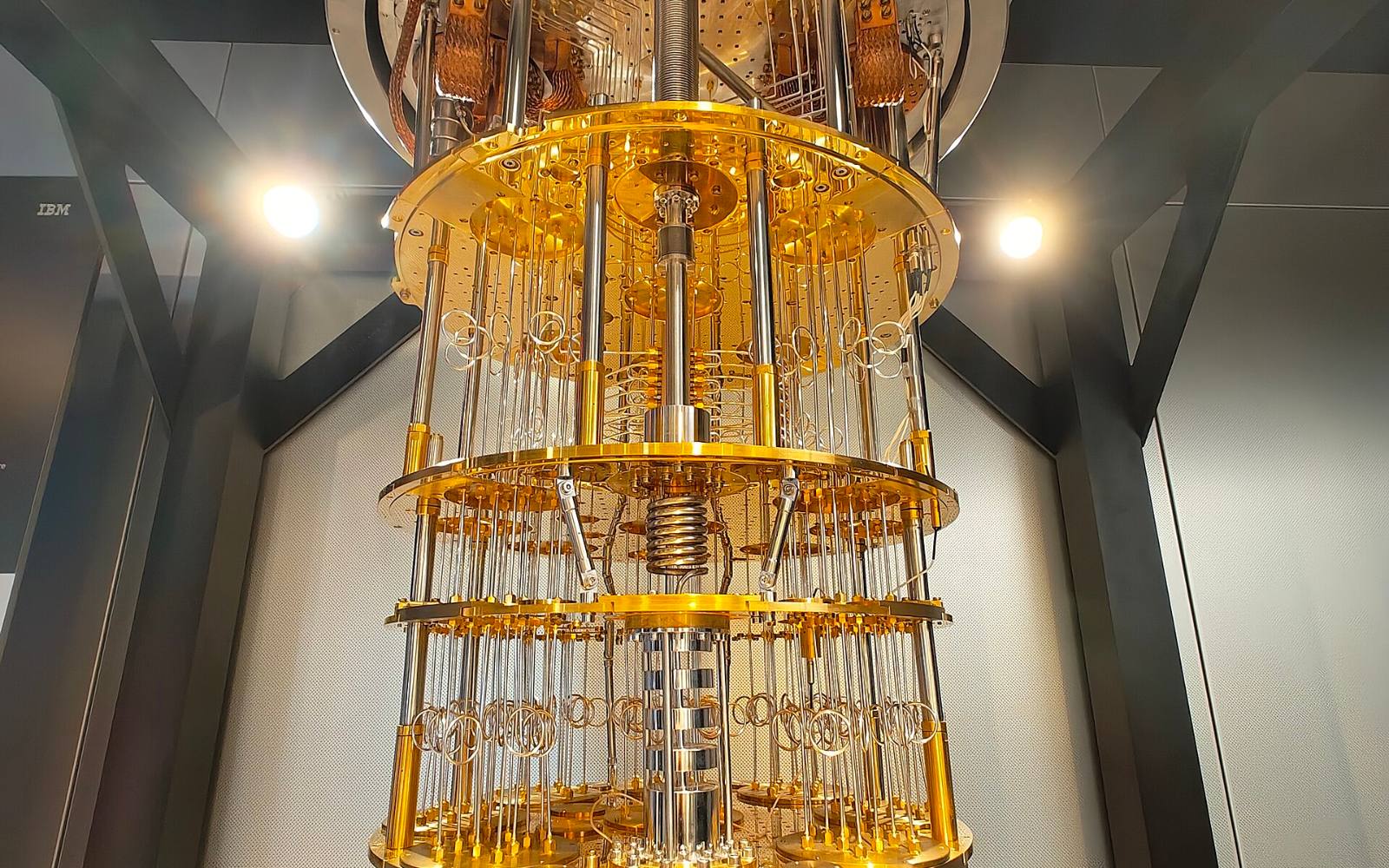
Today's devices are called noisy intermediate-scale quantum (NISQ) machines. Some designs must be cooled to about 20 millikelvin, close to absolute zero, using a dilution refrigerator, which is one reason NIST expects quantum computers to sit in computing centres, labs and universities rather than on desks.
Types of qubit
- Trapped ion: holds its state a long time but computes relatively slowly
- Superconducting: fast and made with chip-making techniques, but states last a shorter time
- Neutral atom, semiconductor and photonic: also under development
- Topological: hypothetical, not yet made in a lab, designed to resist errors
Claims of advantage
In October 2019 Google claimed quantum supremacy with a 54-qubit machine on a specially chosen task; IBM disputed this, arguing a classical supercomputer could do it in about 2.5 days rather than the 10,000 years claimed. NIST says early demonstrations of quantum advantage, such as small-molecule energies, have not yet proved truly useful and that classical computers have sometimes matched them.
Sources
Image credits: Cover photo: IBM Quantum System One by OJB Quantum, CC BY 4.0. Pictures from Wikimedia Commons.

Share
Keep reading
Related articles
How a VPN Works: Tunnels, Encryption and Limits
A VPN wraps your traffic in an encrypted tunnel to another network. Here is how that works, which protocols are used and what a VPN cannot hide from others.
How End-to-End Encryption Keeps Messages Private
End-to-end encryption means only the sender and receiver can read a message, not even the service carrying it. Here is how keys, ratchets and safety numbers fit together, and what it cannot protect.
How Email Travels: SMTP, MX Records, IMAP and POP3
Email passes through several programs and servers between sender and inbox. Here is the route, what MX records and SMTP do, and how IMAP differs from POP3.